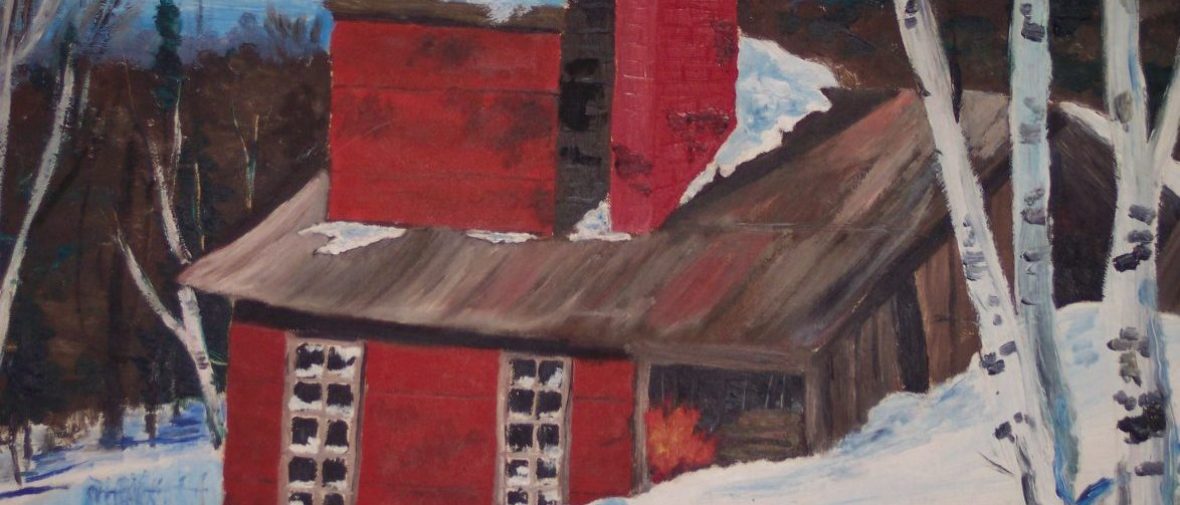
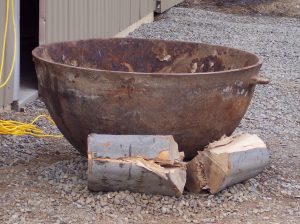
Campbell Maple is a family owned and run maple business operating in Cuba, New York. The Campbell family has resided here for 200 years. In the fall of 1822, the same year that Cuba Township was created, Robert Campbell and two of his sons, James M. and Dillon, left Pompey, NY and made a 10 day journey with an ox team to start a new home in Cuba. In the spring of 1823, Robert’s youngest son, Rufus R. joined his father and brothers. They settled on Jackson Hill Road in the town of Cuba, NY buying land from the Holland Land Company. They began clearing the land to farm and building a home. The land also contained a nice stand of maple trees. Currently the sugarbush consists of 50 acres. Using the iron kettle they had brought with them, they boiled sap that was collected from the maple trees. At this time, wooden buckets and spiles would have been used to collect the sap. Over the years several sugar houses were built in the woods at the top of the hill to boil the sap. Unfortunately, due to the nature of wood fires at least one sugarhouse succumbed to fire. The last sugar house to be built in the woods is illustrated by the painting on the home page of the website. This painting was done by Mr. Bosworth in 1960. As maple syrup production evolved, wooden buckets were replaced by galvanized buckets and spiles. While the sugarhouse in the woods was convenient for the collection of sap and boiling, it was half a mile up a steep hill to get to.
It was decided to build a sugarhouse more convenient to the homes and farm. This sugarhouse served the family until 2009. An area next to the sugarhouse was dug out of a hill to house the sap holding tank. This kept the sap cool. At this time, the sap was still collected manually-people had to empty the buckets into a collection tank that was transported down the hill to the sap house. Sap was boiled using a wood fired evaporator as it is now. Locals may remember visiting this sugarhouse as school children. It was a bit of a walk through the cow pasture. A fond memory of this time was walking into the sugarhouse full of steam so thick you could only see the person right next to you. Maple production embraced new innovations with plastic tubing replacing buckets.
In 2009, when Kim Campbell, 6th generation, made the decision to build a new sugarhouse, he wanted it to have the modernizations available at the time and to be easily accessible. A new wood fired efficiency evaporator was installed. Included was an area for three tanks to store the sap. New plastic tubing was installed. 2500 feet of mainline tubing was buried from the woods to the sugarhouse to transport the sap. There is about 12,500 feet of plastic tubing in the sugarbush. The sap is brought to the sugarhouse using a vacuum system. Currently there are 3300 taps. Due to the efficiency of the evaporation process, steam no longer fills the building.
In 2012, a Reverse Osmosis (RO) system and filter press were added to make maple syrup production faster.
For generations, farming was the main enterprise and maple syrup was the hobby. At first it was produced for family and over time sold to others. Maple syrup was the main product but locals may remember my Grandmother Helen Burt Campbell’s maple candy. It was creamy and melted in your mouth. She also made maple cream using a stand mixer. Following this tradition, we decided to add the production of maple cream and several years’ later maple candy. Two different machines were added to assist in this process. Maple granulated sugar and maple popcorn were also added to the confections produced for sale.
In 2020, a small room was created so the maple confection production had its own space.
Currently, 6th and 7th generation Campbells live on the land first settled in 1822. They continue to enjoy making maple syrup and sharing it with the community.


 Campbell Maple